
Malaria, a Global Health Challenge
Malaria remains one of the most devastating infectious diseases worldwide, primarily affecting Sub-Saharan Africa, where over 95% of cases and deaths occur. In 2023, the World Health Organization reported 263 million cases and nearly 600,000 deaths, mostly among children and pregnant women. The responsible parasite, Plasmodium falciparum, transmitted by Anopheles mosquitoes, is particularly virulent.
Current treatments largely rely on Artemisinin-based Combination Therapies (ACTs). However, growing resistance to these medications, observed in Southeast Asia and East Africa, worsens the struggle against the disease. Moreover, vaccines such as RTS,S and R21, though innovative, have limited efficacy and are primarily targeted at young children.
An Innovative Response: a Natural and Effective Antimalarial

The Dimalphar project, led by Professor Jacob Souopgui, aims to develop an innovative antimalarial drug based on Artemisia afra, a traditional African medicinal plant. This product, is designed not only to kill parasites sensitive and resistant to ACTs but also to eliminate the silent human reservoirs of the parasite responsible for continued transmission.
Dimalphar brings together multidisciplinary expertise in pharmacology, parasitology, and biotechnology, and values African ethnopharmacological knowledge. The drug is subject to a European patent application and benefits from significant funding supporting all development phases: formulation, preclinical and clinical trials, up to industrial production.
Strategic Objectives of the Project
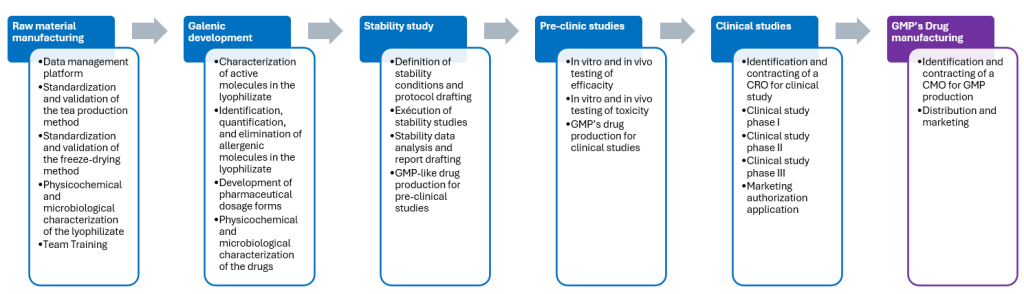
Under the leadership of Professor Jacob Souopgui, an international biotechnology expert, the project spans 60 months with a budget of over 104 million euros. Its main objectives include:
- Production of raw material and implementation of a data management system
- Pharmaceutical formulation development
- Accelerated stability studies
- Preclinical studies
- Clinical trials
Scientific and Social Impact
Dimalphar aims to revolutionize the fight against malaria by offering a safe, affordable, and locally produced alternative. In doing so, the project contributes to African health sovereignty and the achievement of the Sustainable Development Goals.
Preliminary results highlight Gotesse’s ability to interrupt the malaria transmission cycle by directly targeting resistant parasites and eliminating asymptomatic carriers. This dual action could accelerate malaria eradication in Africa and prevent a public health crisis worsened by climate change.